Posts

80-20 Rules of Safety Management

Image
Effective Safety management is a “system approach” and is certainly not a “ piecemeal activity” .   Like any other business function, it also requires careful planning, efficient organisation, adequate resource allocation and sound monitoring and evaluation process. Conventional approach and generic activities render safety function missing the objective of the organisation year after year. In every management it is said that efforts and resources applied to preventing the occurrence that lead to defects in quality, deteriorated environment or injury in due course of business is economical and effective. This is true to safety management too. Unfortunately, most business focuses more for situations developed after business upsets. In the name of improving safety performance, an organisation runs many programs that address the problems surfaced after an accident (a potential business upset). The accident may be a situation related to release/spill of chemicals, fire/e...

Balancing Safety-How much Important?

Image
With the increasing industrialisation with newest process technology, the challenge to safety to protect human being from dangers encountered in due course of employment is also increasing proportionately. In this situation, the approach to safety with yesterday’s tactics won’t yield good result. It is essential to consider each contributory cause of an accident while planning for good safety performance. To reach ultimately closer to ZERO accident - a long term vision, safety must compete with other business functions. In turn, safety management system needs to balance all elements of an accident causation model. Apart from other paradigm shifts in safety, one such important shift is a thought process to see safety as a “system approach” and not as “ piecemeal activity” . We see many organisation claims to ZERO accident for a few years randomly and all of a sudden, they experience spurt of accidents following years. The reason behind this is many but also is because of lack of h...

Accidents do not affect Bottom-line – Is it so?

After a long gap, I’m constrained to write this article in wake of recent spur in accidents-fire, crane/building collapse, mine collapse etc. wherein many are losing lives apart from damage to property and environment. The bottom-line of any business is net profit. Resources are deployed, operated, monitored, and coordinated in a way so as to maximise return on it as net profit. Of all these resources, human resource is considered to be very invaluable, expensive, dynamic yet very sensitive. The business that respect and care for this scarce resource, have been witnessed leading others in their respective fields. There are several ways to demonstrate respect and care of this scarce resource, however providing employee a safe and healthy workplace and ensuring their return to home without injury should find a place above all. As a high human caring business, safety of the employee should be foremost value and should be considered in the core of all planning. However for many, Safe...

Your Adversity Quotient (AQ)

Very often, we succumb to the problems (adversity) that come in our way in our day to day life. We seldom try to resolve and get out of the same in order to avoid effect of the one problem in one area of life to other. How many adverse events do you experience on your average day? Are you consumed by these events or are you letting them lead to stronger performance? I developed the Adversity Quotient (AQ) to test the unconscious pattern of how people respond to adversity, and show how to increase it and, thereby, help individuals become valuable at work. Adversity Response Profile (ARP) Imagine the following events as if they were happening right now. Then circle the number that represents your answer to each of the related questions. You suffer a financial setback. To what extent can you influence this situation? Not at all       1        2         3    ...

How knowing about MF of HazChem helps?

Image
Material Factor (MF) of Hazardous chemicals   Definition: Material Factor is a measure of the energy potential of the most hazardous material, or mixture of material, present. MF denoted by a numerical from 0 to 40, with 40 being the highest and 0 the lowest energy containing materials. The degree of hazards associated with the material also indicated by the number in increasing order from 0 to 40. Importance of Material Factor (MF): The direct (fire heat burn) or indirect (fire caused smoke or reaction product) injury or health hazards arising from any chemical is decided prominently by three characteristic factors, e.g. flammability, reactivity, and toxicity.   Therefore, understanding of MF - as function of these factors, by all those who are associated with handling (storing, dispensing, shifting, processing, using, transporting, pumping, loading, unloading, and disposing) is important in order to take necessary control measures to avoid explosion, fire, and/or...

How fire safe is your home?

Image
It is surprising that even after many fire accidents, nothing much is being done in the direction of prevention. Most efforts are being directed in improving fighting techniques and latest protection equipments rather than maintaining the electrical cabling system in healthy condition.   It does not mean that these efforts should be abandoned, but efforts towards prevention of fire accidents should be given due consideration. Data indicates that most of the fire accidents in industry, home, mall etc are because of electricity and in those accidents most accounts for short circuiting in wiring/cabling system. Faulty wiring is the leading cause of residential fires, according to a 2009 study by the National Fire Prevention Association. We always repair the fault in the circuit rather than getting inspected/tested by competent electrician at a regular interval. Sometimes the deteriorated wiring led to fire accidents in schools, hospitals, malls, industry etc and snatch...

Know how deadly ‘Blast over Pressure’ is?

Image
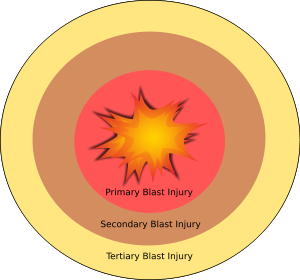
Overpressure (or blast overpressure) is the pressure caused by a shock wave over and above normal atmospheric pressure . The shock wave may be caused by explosion or sonic boom . A measured over pressure is basis to know the effects of nuclear explosion or bomb explosion. The injury caused by the blast over pressure is known as blast injury. Mechanism Blast injuries can result from various types of incidents ranging from industrial accidents to terrorist attacks. High-order explosives produce a supersonic overpressure shock wave, while low order explosives deflagrate and do not produce an overpressure wave. A blast wave generated by an explosion starts with a single pulse of increased air pressure, lasting a few milliseconds . The negative pressure ( suction ) of the blast wave follows immediately after the positive wave. The duration of the blast wave depends on the type of explosive material and the distance from the point of detonation. The blast wave progresses from...